In the global B2B tea market, a lingering debate often puzzles international buyers and food scientists: Where did Matcha truly originate? Is it an ancient Chinese invention, or is it exclusively Japanese?
Lately, the phrase “China is the birthplace of world matcha” has gained traction. While historically grounded, this simplified statement can cause profound misunderstandings among Western premium brands if not properly contextualized.
At Shanghai Leisure Leaf Trading Co., Ltd., we value cultural honesty and technical precision above all else. To source, formulate, and appreciate premium bulk matcha powder, one must understand that the relationship between Chinese historical powdered tea and modern Japanese Matcha is not a matter of one replacing the other, but a beautiful story of common roots and divergent evolution.
Here is the objective historical and technological clarification.
1. The Common Origin: The Steamed Powdered Tea of the Song Dynasty (960–1279 AD)
It is a historical fact that the concept of drinking powdered green tea originated in China.
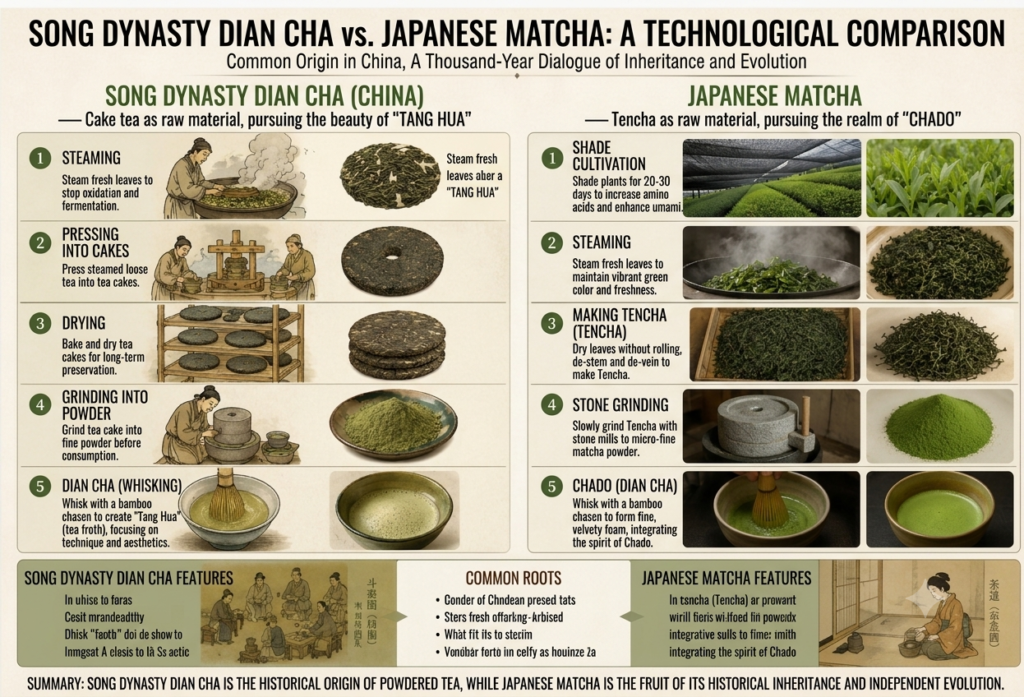
During the Tang Dynasty and reaching its absolute pinnacle in the Song Dynasty, tea was processed through a method called Dian Cha (点茶). Fresh tea leaves were harvested, steamed to stop oxidation (preserving the green enzymes), pressed into solid tea cakes, dried for storage, and then ground into fine powder inside a mortar right before consumption.
The Song Dynasty elites used a bamboo whisk (Chasen or Cha Xian) to vigorously beat the tea in a bowl, creating a thick, creamy white froth known as Tang Hua (汤花). During this era, Japanese Buddhist monks (such as Eisai) traveled to China, studied Zen Buddhism and Dian Cha, and brought this exquisite powdered tea ritual back to Japan.
2. The Historical Divergence: The Chinese Discontinuation vs. The Japanese Preservation
The turning point occurred in 1391 AD during the Ming Dynasty. The Emperor issued an imperial decree banning the production of compressed tea cakes to alleviate the heavy labor burden on tea farmers, promoting loose-leaf tea instead.
Overnight, China’s powdered tea culture, along with the steaming, whisking, and stone-grinding techniques, completely faded from Chinese daily life. For the next 600 years, China became a world leader in loose-leaf teas: oolong, black, jasmine, and pan-fired green tea (like Longjing).
Meanwhile, Japan meticulously preserved the Song Dynasty powdered tea seed. Safe within Zen monasteries, this ancient Chinese ritual evolved independently over centuries, eventually transforming into Chado (茶道 – The Way of Tea).
3. The Technological Evolution: Why Modern Matcha is Different from Ancient Dian Cha
This is where clarification is vital for modern B2B buyers. Modern premium Matcha is not simply a copy-paste of ancient Chinese Dian Cha. Japan did not just preserve the technique; they revolutionized it through distinct agricultural and industrial innovations:
- Tana Cultivation (Shade-Grown): This is a Japanese innovation. Shading the tea fields under black nets for 20-30 days before harvest forces the plants to produce massive amounts of chlorophyll and L-theanine. This turns the leaves a vibrant jade green and eliminates bitterness, creating that sweet, savory umami flavor profile. Ancient Dian Cha did not utilize this extensive shading process.
- The Creation of Tencha (No Rolling): In traditional Chinese tea-making, leaves are rolled. For modern matcha, the steamed leaves are dried completely flat without rolling, and a complex machinery process removes 100% of the bitter stems and veins. The remaining pure leaf flesh is called Tencha.
- Granite Stone-Grinding: Tencha is slowly ground by heavy granite mills at ultra-low speeds to prevent friction heat from yellowing the tea. This results in an incredibly fine particle size (5–10 microns) that dissolves perfectly into milk and water, feeling completely smooth on the palate.
4. Our Philosophy: Honoring History, Mastering the Modern Standard
Today, the global demand for matcha is skyrocketing—from ready-to-drink (RTD) lattes to nutraceuticals. At Shanghai Leisure Leaf Trading, we don’t try to blur the lines.
We proudly acknowledge that China is the ancestral birthplace of the powdered tea philosophy, but we also deeply respect the exquisite manufacturing standards refined by centuries of evolution.
Our supply chain bridges the best of both worlds. Nestled in pristine, high-altitude microclimates in China that mirror the finest terroirs, we implement the modern standards of authentic Matcha production—including strict pre-harvest shade-growing, precise steaming, accurate de-stemming for Tencha, and state-of-the-art micro-milling. More importantly, we back this heritage with rigorous international compliance, ensuring zero-pesticide risk and full EU/FDA alignment.
Conclusion
Is matcha Chinese or Japanese? Historically, it belongs to a grand cultural exchange. Technologically, modern Matcha is a refined industrial standard.
By understanding this difference, global brands can make informed choices, celebrating the ancient roots while demanding the absolute highest modern compliance and taste profile for their customers.